
21 November 2026 · Updated 21 November 2026
By Avil Rakshith Salins, Practising Company Secretary
ESOPs done right: board, shareholders, valuation and the filings
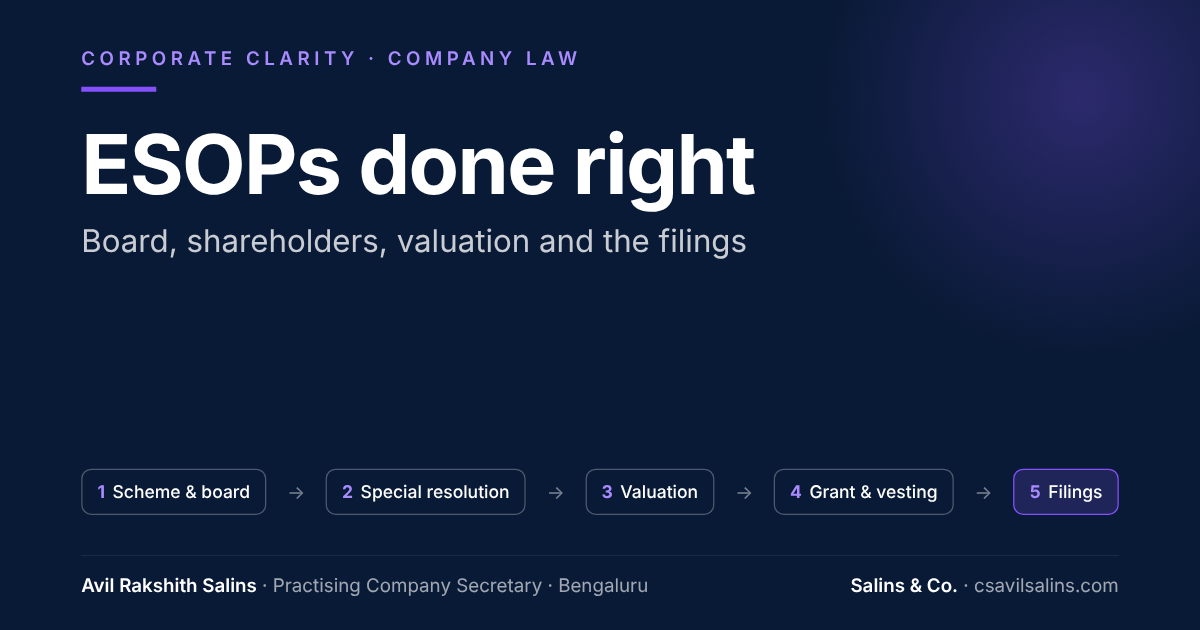
An ESOP in a private company is valid only if four things line up: a scheme the board approves, a special resolution of the shareholders, a price set and recorded properly, and the filings and registers that follow.
Practice areas
This article walks through each step for an unlisted company under section 62(1)(b) of the Companies Act, 2013 and rule 12 of the Companies (Share Capital and Debentures) Rules, 2014. Listed companies follow SEBI's regulations instead (rule 12(11)). Most ESOP problems surface years later, at a funding round or due diligence, when one of the steps turns out to be missing.
The law in short
Options can go to permanent employees and non-independent directors; promoters and large shareholders are excluded unless the company is a recognised startup.
Step 1: the scheme and the board
Check the articles and the capital first: nothing in the articles should restrict an ESOP, and the authorised capital must cover the shares in the pool. If either falls short, change it first.
Then draft the scheme. It sets the pool size, who is eligible, the vesting schedule, the exercise price or the formula for it, the exercise period, and what happens when an employee leaves. The board approves the scheme and the notice of the general meeting, including the explanatory statement that rule 12(2) requires. The scheme is the document investors and auditors will read later; a one-page term sheet is not a scheme.
Step 2: the shareholders
The shareholders approve the scheme by special resolution, and the company files MGT-14 within 30 days (section 117). The explanatory statement must carry the rule 12(2) disclosures, including the pool size, vesting, the exercise price or formula, the exercise period, any lock-in and the method used to value the options.
Grants to employees of a holding or subsidiary company, and grants to one employee of 1% or more of the issued capital in a year, each need their own special resolution (rule 12(4)). Other grants are made as the scheme provides, usually by the board or a board committee; shareholders do not approve each grant.
Step 3: valuation and pricing
Rule 12(3) lets the company set the exercise price freely, in line with applicable accounting policies; there is no statutory minimum price for an unlisted company. The explanatory statement must state how the company will value its options (rule 12(2)), and where a valuation of the shares is needed, a registered valuer or a merchant banker prepares it.
Options are an employee cost in the company's financial statements under the applicable accounting standard, so the statutory auditor will look at how they are valued. The employee is taxed when the options are exercised and again when the shares are sold; the company's chartered accountant advises which valuation report the income-tax rules require and the withholding that applies.
Step 4: grant, vesting and exercise
The board or its committee grants the options; each employee gets a grant letter, and the grant goes into the register in Form SH-6. Options vest as the scheme says, never earlier than one year from grant (rule 12(6)(a)). The employee exercises within the exercise period and pays the exercise price, and the board allots the shares.
Step 5: the filings and records
Issuing shares to a non-resident employee may bring in FEMA reporting. Plan for it before the first grant, not at exercise.
The trust route, in brief
Some companies run their ESOP through an employee welfare trust instead of issuing shares directly. Section 67(3)(b) of the Companies Act, 2013 permits a company to provide money for trustees to buy its shares for the benefit of employees, subject to the conditions in rule 16 of the Companies (Share Capital and Debentures) Rules, 2014. The trust route has its own approvals, limits and disclosures, so decide between the two routes before drafting the scheme.
Common mistakes
Options granted on a board resolution alone, with no special resolution. Options promised to a founder or a 10% director in a company that is not a DPIIT startup, or is past ten years. Vesting earlier than one year from grant, or cliff terms in an offer letter that contradict the scheme. An explanatory statement missing the rule 12(2) disclosures. MGT-14 or PAS-3 filed late or not at all. No SH-6 register. A pool larger than the unissued authorised capital. Grants to non-resident employees with no thought for FEMA reporting. ESOP details left out of the Board's report.
Position stated as on 21 November 2026. Check for any later MCA notification before acting.
General information, not advice on any particular company. Take advice on your own facts before acting.
Frequently asked questions
Sources
- Companies Act, 2013: sections 39(4), 62(1)(b), 67(3)(b) and 117
- Companies (Share Capital and Debentures) Rules, 2014: rules 12 and 16
Verify the primary source current on the date of your filing.