
11 November 2026 · Updated 11 November 2026
By Avil Rakshith Salins, Practising Company Secretary
FC-TRS: due date, who files it, and fixing a late one
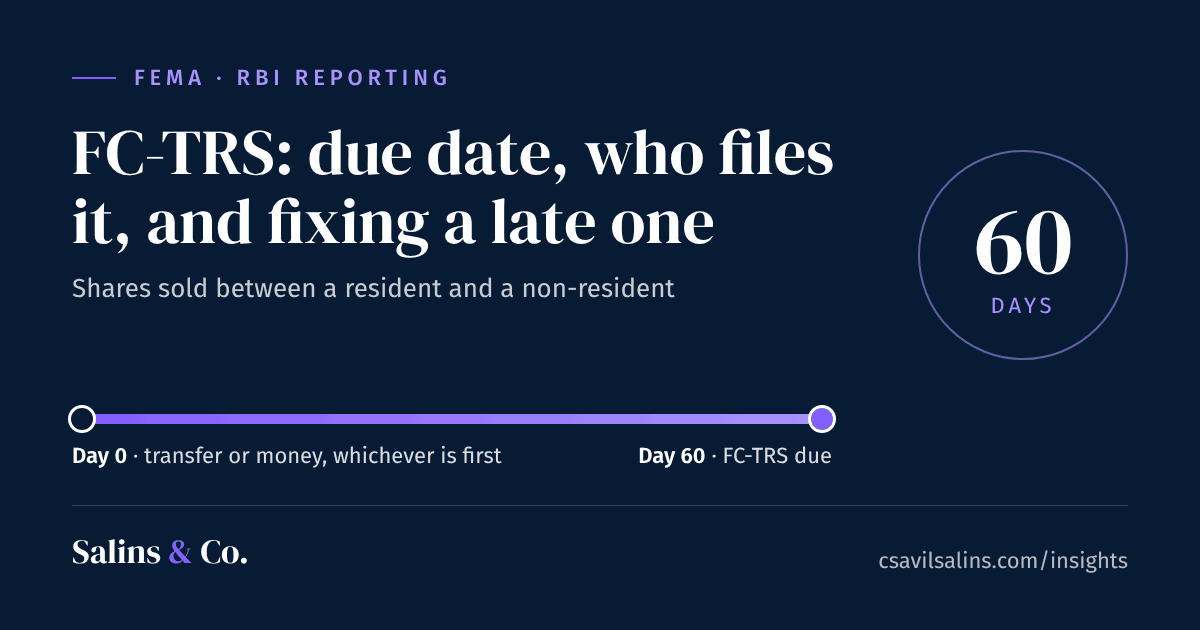
When shares move between someone in India and someone outside India, the sale is reported to the RBI in Form FC-TRS within 60 days of the transfer or the money, whichever is earlier. The party in India usually files it through its bank. A late report can still be filed with a late submission fee for up to three years.
Form FC-TRS guide: due date, pricing and documents →
Sources
- FEMA (Mode of Payment and Reporting of Non-Debt Instruments) Regulations, 2019 (FEMA 395/2019-RB), regulations 4(3) and 5
- RBI Master Direction – Foreign Investment in India, paras 7.9, 8.2, 8.3 and 8.11
- RBI A.P. (DIR Series) Circular No. 16, Late Submission Fee for reporting delays under FEMA, 30 September 2022
- RBI A.P. (DIR Series) Circular No. 22, reporting in Single Master Form on FIRMS, 4 January 2023
Verify the primary source current on the date of your filing.
Practice areas
In short: when shares of an Indian company move between someone in India and someone outside India, the sale has to be reported to the RBI in Form FC-TRS. The report is due within 60 days of the share transfer or of the money moving, whichever happens first. The party in India usually files it, through its bank. If the 60 days have passed, the report can still be filed with a late submission fee.
What FC-TRS is
FC-TRS is the form that tells the RBI about a sale of shares between a person resident in India and a person resident outside India. It does not matter which way the shares move. An Indian founder selling to a foreign investor needs it, and so does a foreign shareholder selling back to an Indian buyer.
It is not needed when both sides are in India, or when both sides are outside India. And if the non-resident holds the shares on a non-repatriable basis (money that cannot be taken out of India) and sells them to a resident, that sale is not reported in FC-TRS.
The due date: 60 days, from whichever comes first
The form is due within 60 days of the transfer of the shares, or the receipt or remittance of the money, whichever is earlier. The words "whichever is earlier" are where most people go wrong: the clock starts on the first of the two events, not the last.
Example: a foreign investor pays for the shares on 20 December. The shares are transferred on 10 January. The 60 days run from 20 December, because the money came first, so FC-TRS is due by 18 February, not 11 March.
Who files it
- Usually the party in India, whether that party is the buyer or the seller.
- The non-resident files it when the non-resident sells the shares on a recognised stock exchange.
- Part of the price paid later? Up to 25% of the price can be paid later, held in escrow or covered by an indemnity, for up to 18 months. FC-TRS is then filed each time a part of the price is received, by the party in India.
The report is made through the party's bank (the AD bank), in the Single Master Form on the RBI's FIRMS portal. The form and its supporting documents are uploaded there, and the bank checks them, within five working days under the RBI's circular. Keep the transfer agreement, the valuation certificate and the proof of payment ready before you start.
The price has to follow the FEMA rules
- A resident selling to a non-resident cannot sell below fair value.
- A non-resident selling to a resident cannot sell above fair value.
For an unlisted company, fair value is supported by a valuation on an arm's length basis, using an internationally accepted method, certified by a chartered accountant, a SEBI-registered merchant banker or a practising cost accountant. The valuation should not be more than 90 days old. The foreign investor cannot be promised a fixed exit price: they exit at the price that applies when they sell.
Missed the 60 days?
You can still file. The person responsible pays a late submission fee of ₹7,500 plus 0.025% of the amount involved for each year of delay, with the delay counted in months. It is charged for each late form, and it can never be more than the amount involved.
Example: a transfer of ₹50 lakh is reported 14 months late. The delay is 1.17 years. The fee is ₹7,500 + (0.025% × ₹50,00,000 × 1.17), which comes to about ₹9,000.
The late fee route is open for up to three years from the due date. After three years, the bank can approve the form only once the default has been compounded with the RBI, which is a longer and costlier process. So the sooner a late FC-TRS is filed, the better.
To fix a late FC-TRS:
- 1. Work out the correct due date, from whichever came first: the transfer or the money.
- 2. Collect the documents, including a valuation as on the date of the transfer.
- 3. File FC-TRS through your bank on FIRMS and pay the late submission fee.
- 4. Keep the acknowledgment with the company's share transfer records.
Don't forget the Companies Act side
The company still records the transfer in its register of members. A private company covered by rule 9B can transfer shares only in demat form, so physical shares must be dematerialised first. If a significant beneficial owner changes, BEN-2 may also be due.
A quick checklist
- Is one side in India and the other outside India? Then FC-TRS applies.
- Note both dates, the share transfer and the money, and count 60 days from the earlier one.
- Check the price against a valuation not older than 90 days.
- File through your bank, and keep the acknowledgment.
- Already late? File now: the fee grows with time, and after three years compounding is needed.
This note gives general information on the law as on 11 November 2026. It is not advice on any particular transaction.
Frequently asked questions